Header Parameter Models
If you have a group of related header parameters, you can create a Pydantic model to declare them.
This would allow you to re-use the model in multiple places and also to declare validations and metadata for all the parameters at once. 😎
Header Parameters with a Pydantic Model
Section titled “Header Parameters with a Pydantic Model”Declare the header parameters that you need in a Pydantic model, and then declare the parameter as Header:
from typing import Annotated

from fastapi import FastAPI, Header
from pydantic import BaseModel

app = FastAPI()


class CommonHeaders(BaseModel):
    host: str
    save_data: bool
    if_modified_since: str | None = None
    traceparent: str | None = None
    x_tag: list[str] = []


@app.get("/items/")
async def read_items(headers: Annotated[CommonHeaders, Header()]):
    return headers
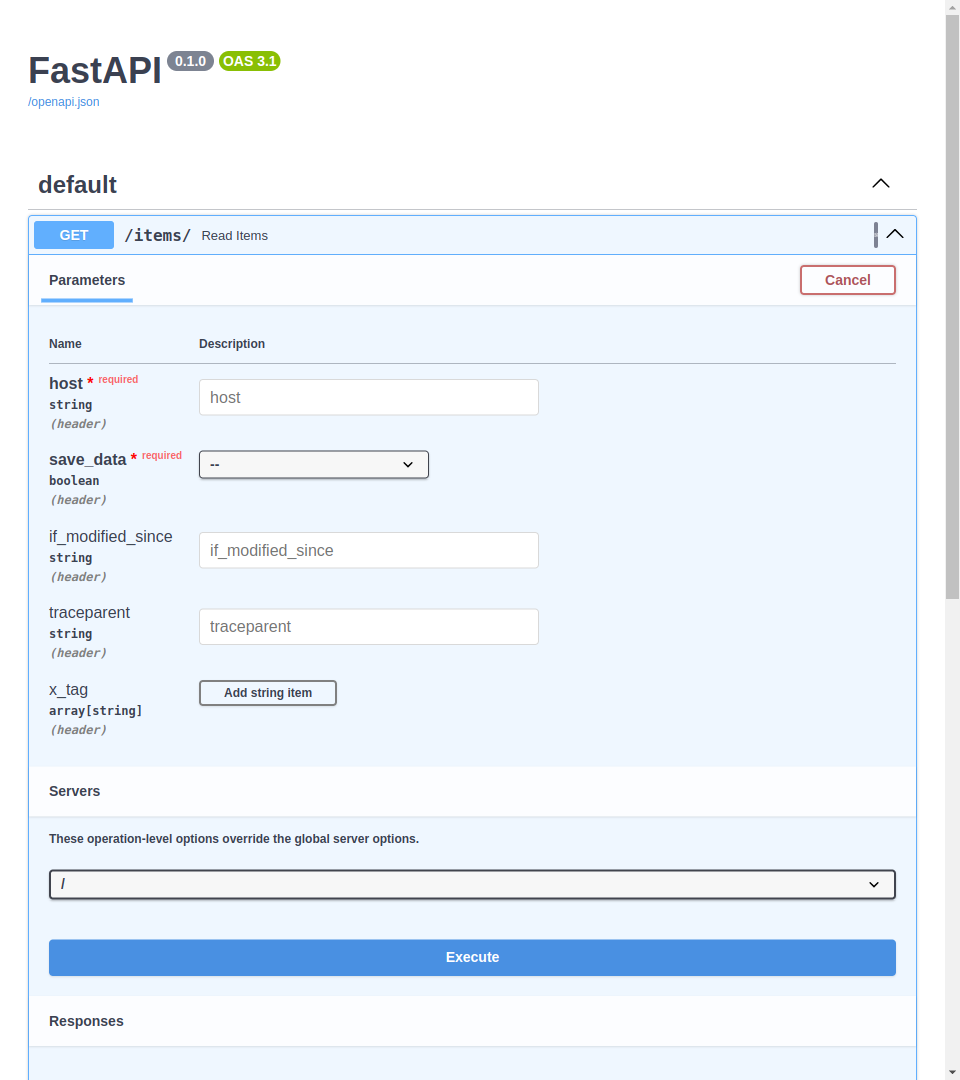
FastAPI will extract the data for each field from the headers in the request and give you the Pydantic model you defined.
Check the Docs
Section titled “Check the Docs”You can see the required headers in the docs UI at /docs:
Forbid Extra Headers
Section titled “Forbid Extra Headers”In some special use cases (probably not very common), you might want to restrict the headers that you want to receive.
You can use Pydantic's model configuration to forbid any extra fields:
from typing import Annotated

from fastapi import FastAPI, Header
from pydantic import BaseModel

app = FastAPI()


class CommonHeaders(BaseModel):
    model_config = {"extra": "forbid"}

    host: str
    save_data: bool
    if_modified_since: str | None = None
    traceparent: str | None = None
    x_tag: list[str] = []


@app.get("/items/")
async def read_items(headers: Annotated[CommonHeaders, Header()]):
    return headers
If a client tries to send some extra headers, they will receive an error response.
For example, if the client tries to send a tool header with a value of plumbus, they will receive an error response telling them that the header parameter tool is not allowed:
{
    "detail": [
        {
            "type": "extra_forbidden",
            "loc": ["header", "tool"],
            "msg": "Extra inputs are not permitted",
            "input": "plumbus",
        }
    ]
}
Disable Convert Underscores
Section titled “Disable Convert Underscores”The same way as with regular header parameters, when you have underscore characters in the parameter names, they are automatically converted to hyphens.
For example, if you have a header parameter save_data in the code, the expected HTTP header will be save-data, and it will show up like that in the docs.
If for some reason you need to disable this automatic conversion, you can do it as well for Pydantic models for header parameters.
from typing import Annotated

from fastapi import FastAPI, Header
from pydantic import BaseModel

app = FastAPI()


class CommonHeaders(BaseModel):
    host: str
    save_data: bool
    if_modified_since: str | None = None
    traceparent: str | None = None
    x_tag: list[str] = []


@app.get("/items/")
async def read_items(
    headers: Annotated[CommonHeaders, Header(convert_underscores=False)],
):
return headersSummary
Section titled “Summary”You can use Pydantic models to declare headers in FastAPI. 😎