Body - Nested Models
With FastAPI, you can define, validate, document, and use arbitrarily deeply nested models (thanks to Pydantic).
List fields
Section titled “List fields”You can define an attribute to be a subtype. For example, a Python list:
from fastapi import FastAPI
from pydantic import BaseModel

app = FastAPI()


class Item(BaseModel):
    name: str
    description: str | None = None
    price: float
    tax: float | None = None
    tags: list = []


@app.put("/items/{item_id}")
async def update_item(item_id: int, item: Item):
    results = {"item_id": item_id, "item": item}
    return results
This will make tags be a list, although it doesn't declare the type of the elements of the list.
List fields with type parameter
Section titled “List fields with type parameter”But Python has a specific way to declare lists with internal types, or "type parameters":
Declare a list with a type parameter
Section titled “Declare a list with a type parameter”To declare types that have type parameters (internal types), like list, dict, tuple,
pass the internal type(s) as "type parameters" using square brackets: [ and ]
my_list: list[str]That's all standard Python syntax for type declarations.
Use that same standard syntax for model attributes with internal types.
So, in our example, we can make tags be specifically a "list of strings":
from fastapi import FastAPI
from pydantic import BaseModel

app = FastAPI()


class Item(BaseModel):
    name: str
    description: str | None = None
    price: float
    tax: float | None = None
    tags: list[str] = []


@app.put("/items/{item_id}")
async def update_item(item_id: int, item: Item):
    results = {"item_id": item_id, "item": item}
    return results
Set types
Section titled “Set types”But then we think about it, and realize that tags shouldn't repeat, they would probably be unique strings.
And Python has a special data type for sets of unique items, the set.
Then we can declare tags as a set of strings:
from fastapi import FastAPI
from pydantic import BaseModel

app = FastAPI()


class Item(BaseModel):
    name: str
    description: str | None = None
    price: float
    tax: float | None = None
    tags: set[str] = set()


@app.put("/items/{item_id}")
async def update_item(item_id: int, item: Item):
    results = {"item_id": item_id, "item": item}
    return results
With this, even if you receive a request with duplicate data, it will be converted to a set of unique items.
And whenever you output that data, even if the source had duplicates, it will be output as a set of unique items.
And it will be annotated / documented accordingly too.
Nested Models
Section titled “Nested Models”Each attribute of a Pydantic model has a type.
But that type can itself be another Pydantic model.
So, you can declare deeply nested JSON "objects" with specific attribute names, types and validations.
All that, arbitrarily nested.
Define a submodel
Section titled “Define a submodel”For example, we can define an Image model:
from fastapi import FastAPI
from pydantic import BaseModel

app = FastAPI()


class Image(BaseModel):
    url: str
    name: str


class Item(BaseModel):
    name: str
    description: str | None = None
    price: float
    tax: float | None = None
    tags: set[str] = set()
    image: Image | None = None


@app.put("/items/{item_id}")
async def update_item(item_id: int, item: Item):
    results = {"item_id": item_id, "item": item}
    return results
Use the submodel as a type
Section titled “Use the submodel as a type”And then we can use it as the type of an attribute:
from fastapi import FastAPI
from pydantic import BaseModel

app = FastAPI()


class Image(BaseModel):
    url: str
    name: str


class Item(BaseModel):
    name: str
    description: str | None = None
    price: float
    tax: float | None = None
    tags: set[str] = set()
    image: Image | None = None


@app.put("/items/{item_id}")
async def update_item(item_id: int, item: Item):
    results = {"item_id": item_id, "item": item}
    return results
This would mean that FastAPI would expect a body similar to:
{
    "name": "Foo",
    "description": "The pretender",
    "price": 42.0,
    "tax": 3.2,
    "tags": ["rock", "metal", "bar"],
    "image": {
        "url": "http://example.com/baz.jpg",
        "name": "The Foo live"
    }
}
Again, doing just that declaration, with FastAPI you get:
- Editor support (completion, etc.), even for nested models
- Data conversion
- Data validation
- Automatic documentation
Special types and validation
Section titled “Special types and validation”Apart from normal singular types like str, int, float, etc. you can use more complex singular types that inherit from str.
To see all the options you have, check out Pydantic's Type Overview. You will see some examples in the next chapter.
For example, as in the Image model we have a url field, we can declare it to be an instance of Pydantic's HttpUrl instead of a str:
from fastapi import FastAPI
from pydantic import BaseModel, HttpUrl

app = FastAPI()


class Image(BaseModel):
    url: HttpUrl
    name: str


class Item(BaseModel):
    name: str
    description: str | None = None
    price: float
    tax: float | None = None
    tags: set[str] = set()
    image: Image | None = None


@app.put("/items/{item_id}")
async def update_item(item_id: int, item: Item):
    results = {"item_id": item_id, "item": item}
    return results
The string will be checked to be a valid URL, and documented in JSON Schema / OpenAPI as such.
Attributes with lists of submodels
Section titled “Attributes with lists of submodels”You can also use Pydantic models as subtypes of list, set, etc.:
from fastapi import FastAPI
from pydantic import BaseModel, HttpUrl

app = FastAPI()


class Image(BaseModel):
    url: HttpUrl
    name: str


class Item(BaseModel):
    name: str
    description: str | None = None
    price: float
    tax: float | None = None
    tags: set[str] = set()
    images: list[Image] | None = None


@app.put("/items/{item_id}")
async def update_item(item_id: int, item: Item):
    results = {"item_id": item_id, "item": item}
    return results
This will expect (convert, validate, document, etc.) a JSON body like:
{ "name": "Foo", "description": "The pretender", "price": 42.0, "tax": 3.2, "tags": [ "rock", "metal", "bar" ], "images": [ { "url": "http://example.com/baz.jpg", "name": "The Foo live" }, { "url": "http://example.com/dave.jpg", "name": "The Baz" } ]}Deeply nested models
Section titled “Deeply nested models”You can define arbitrarily deeply nested models:
from fastapi import FastAPI
from pydantic import BaseModel, HttpUrl

app = FastAPI()


class Image(BaseModel):
    url: HttpUrl
    name: str


class Item(BaseModel):
    name: str
    description: str | None = None
    price: float
    tax: float | None = None
    tags: set[str] = set()
    images: list[Image] | None = None


class Offer(BaseModel):
    name: str
    description: str | None = None
    price: float
    items: list[Item]


@app.post("/offers/")
async def create_offer(offer: Offer):
return offerBodies of pure lists
Section titled “Bodies of pure lists”If the top level value of the JSON body you expect is a JSON array (a Python list), you can declare the type in the parameter of the function, the same as in Pydantic models:
images: list[Image]as in:
from fastapi import FastAPI
from pydantic import BaseModel, HttpUrl

app = FastAPI()


class Image(BaseModel):
    url: HttpUrl
    name: str


@app.post("/images/multiple/")
async def create_multiple_images(images: list[Image]):
    return images
Editor support everywhere
Section titled “Editor support everywhere”And you get editor support everywhere.
Even for items inside of lists:
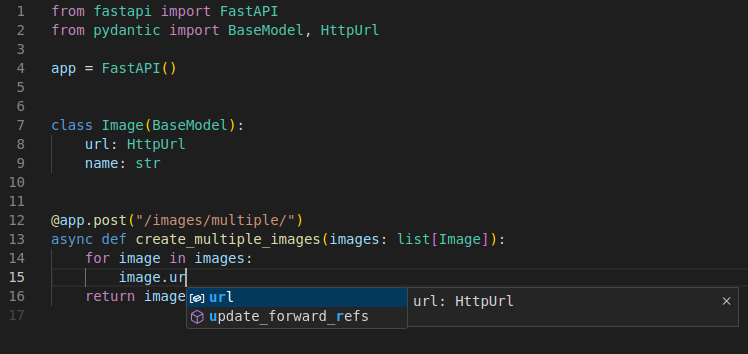
You couldn't get this kind of editor support if you were working directly with dict instead of Pydantic models.
But you don't have to worry about them either, incoming dicts are converted automatically and your output is converted automatically to JSON too.
Bodies of arbitrary dicts
Section titled “Bodies of arbitrary dicts”You can also declare a body as a dict with keys of some type and values of some other type.
This way, you don't have to know beforehand what the valid field/attribute names are (as would be the case with Pydantic models).
This would be useful if you want to receive keys that you don't already know.
Another useful case is when you want to have keys of another type (e.g., int).
That's what we are going to see here.
In this case, you would accept any dict as long as it has int keys with float values:
from fastapi import FastAPI

app = FastAPI()


@app.post("/index-weights/")
async def create_index_weights(weights: dict[int, float]):
return weightsWith FastAPI you have the maximum flexibility provided by Pydantic models, while keeping your code simple, short and elegant.
But with all the benefits:
- Editor support (completion everywhere!)
- Data conversion (a.k.a. parsing / serialization)
- Data validation
- Schema documentation
- Automatic docs