Separate OpenAPI Schemas for Input and Output or Not
Since Pydantic v2 was released, the generated OpenAPI is a bit more exact and correct than before. 😎
In fact, in some cases, it will even have two JSON Schemas in OpenAPI for the same Pydantic model, for input and output, depending on if they have default values.
Let's see how that works and how to change it if you need to do that.
Pydantic Models for Input and Output
Section titled “Pydantic Models for Input and Output”Let's say you have a Pydantic model with default values, like this one:
from fastapi import FastAPI
from pydantic import BaseModel


class Item(BaseModel):
    name: str
    description: str | None = None


app = FastAPI()


@app.post("/items/")
def create_item(item: Item):
    return item


@app.get("/items/")
def read_items() -> list[Item]:
    return [
        Item(
            name="Portal Gun",
            description="Device to travel through the multi-rick-verse",
        ),
        Item(name="Plumbus"),
    ]
Model for Input
Section titled “Model for Input”If you use this model as an input like here:
from fastapi import FastAPI
from pydantic import BaseModel


class Item(BaseModel):
    name: str
    description: str | None = None


app = FastAPI()


@app.post("/items/")
def create_item(item: Item):
    return item


@app.get("/items/")
def read_items() -> list[Item]:
    return [
        Item(
            name="Portal Gun",
            description="Device to travel through the multi-rick-verse",
        ),
        Item(name="Plumbus"),
    ]
...then the description field will not be required. Because it has a default value of None.
Input Model in Docs
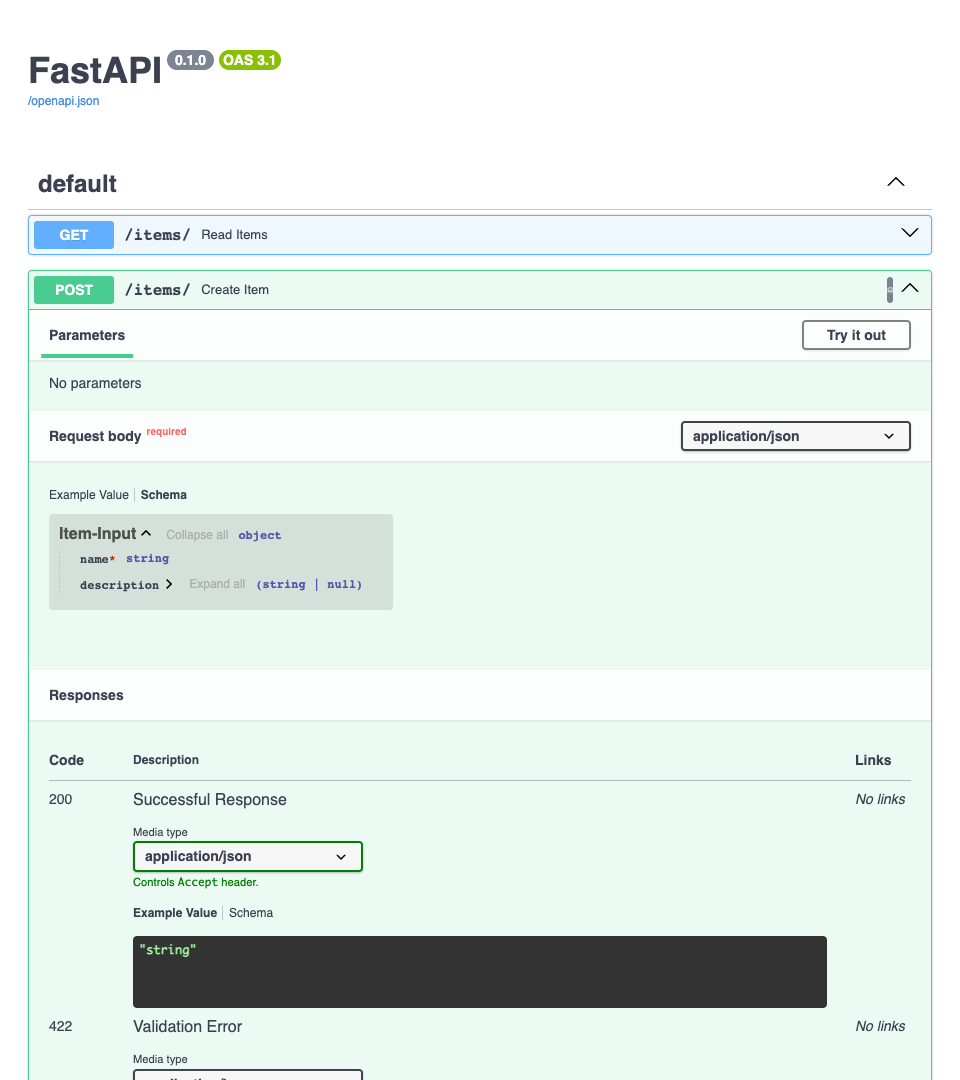
Section titled “Input Model in Docs”You can confirm that in the docs, the description field doesn't have a red asterisk, it's not marked as required:
Model for Output
Section titled “Model for Output”But if you use the same model as an output, like here:
from fastapi import FastAPI
from pydantic import BaseModel


class Item(BaseModel):
    name: str
    description: str | None = None


app = FastAPI()


@app.post("/items/")
def create_item(item: Item):
    return item


@app.get("/items/")
def read_items() -> list[Item]:
    return [
        Item(
            name="Portal Gun",
            description="Device to travel through the multi-rick-verse",
        ),
        Item(name="Plumbus"),
    ]
...then because description has a default value, if you don't return anything for that field, it will still have that default value.
Model for Output Response Data
Section titled “Model for Output Response Data”If you interact with the docs and check the response, even though the code didn't add anything in one of the description fields, the JSON response contains the default value (null):
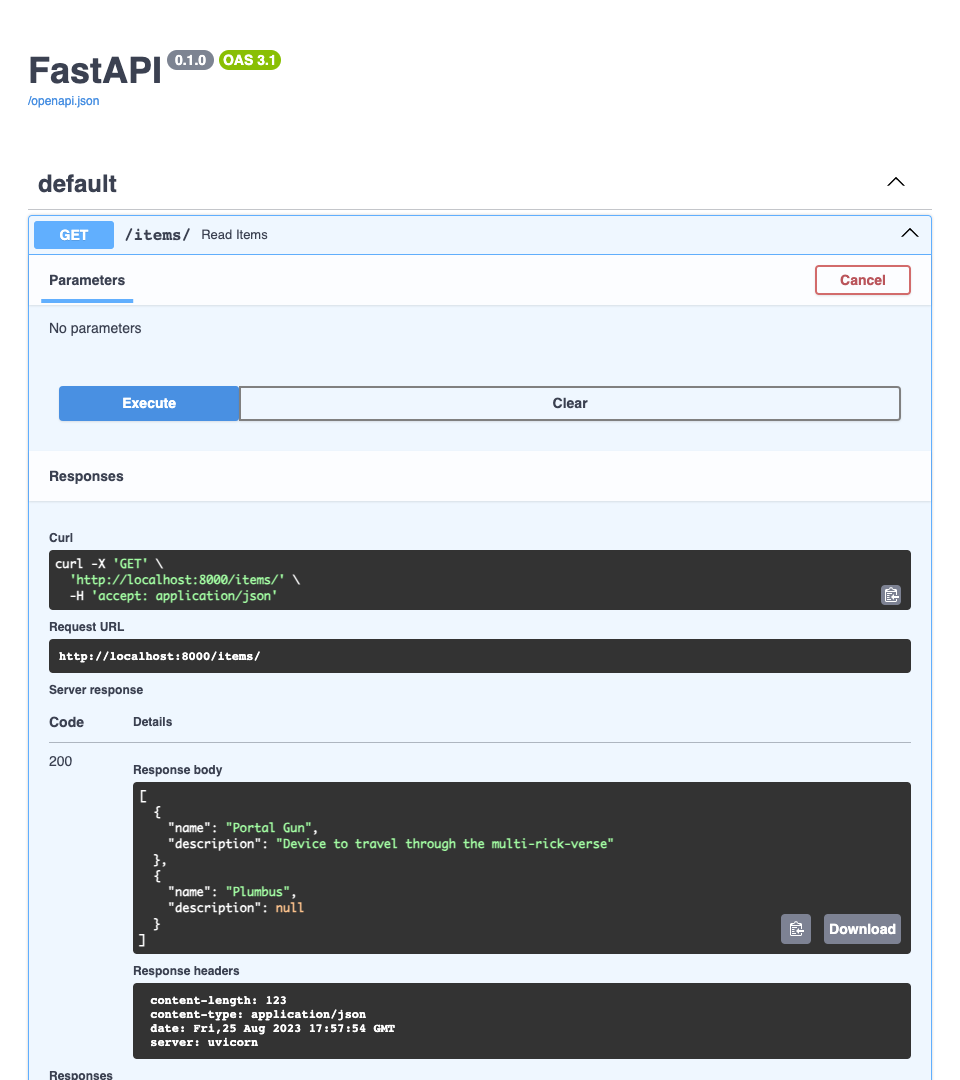
This means that it will always have a value, it's just that sometimes the value could be None (or null in JSON).
That means that clients using your API don't have to check if the value exists or not, they can assume the field will always be there, but just that in some cases it will have the default value of None.
The way to describe this in OpenAPI, is to mark that field as required, because it will always be there.
Because of that, the JSON Schema for a model can be different depending on if it's used for input or output:
- for input the
descriptionwill not be required - for output it will be required (and possibly
None, or in JSON terms,null)
Model for Output in Docs
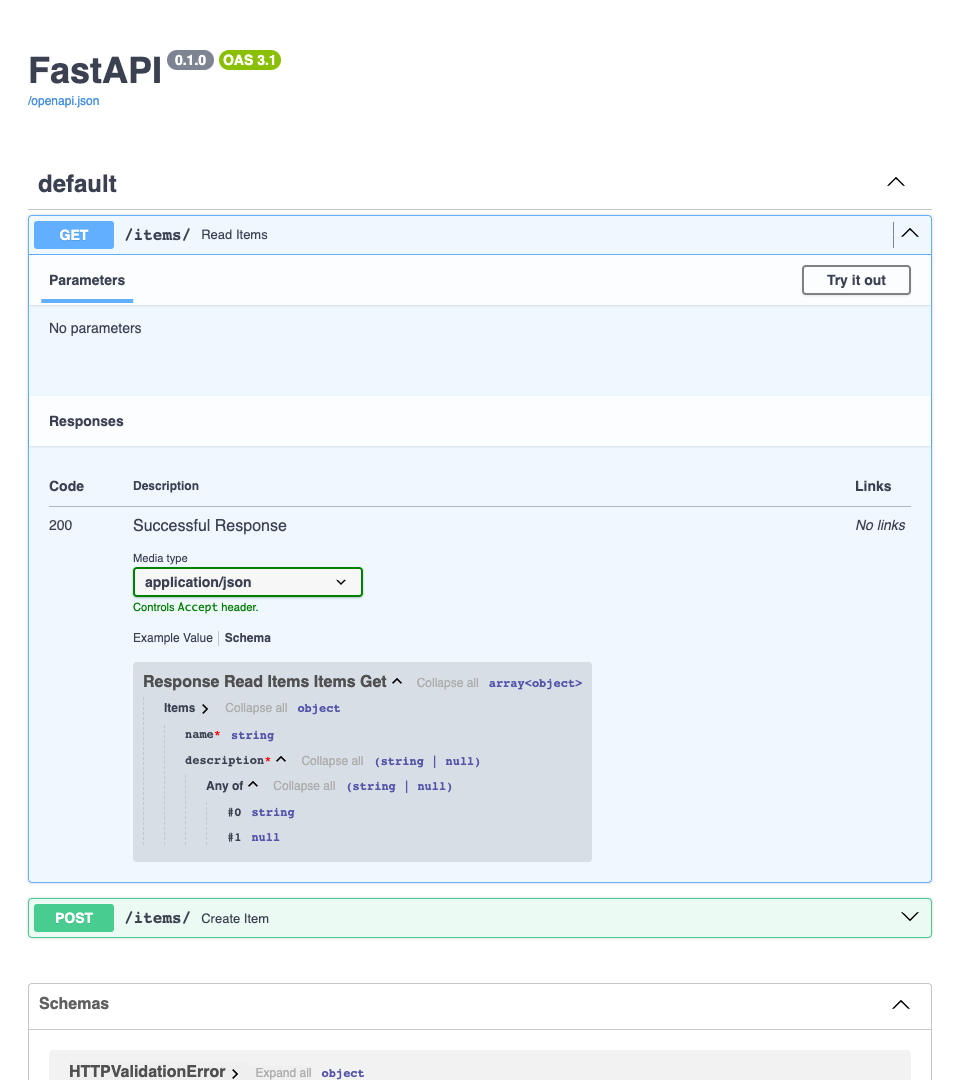
Section titled “Model for Output in Docs”You can check the output model in the docs too, both name and description are marked as required with a red asterisk:
Model for Input and Output in Docs
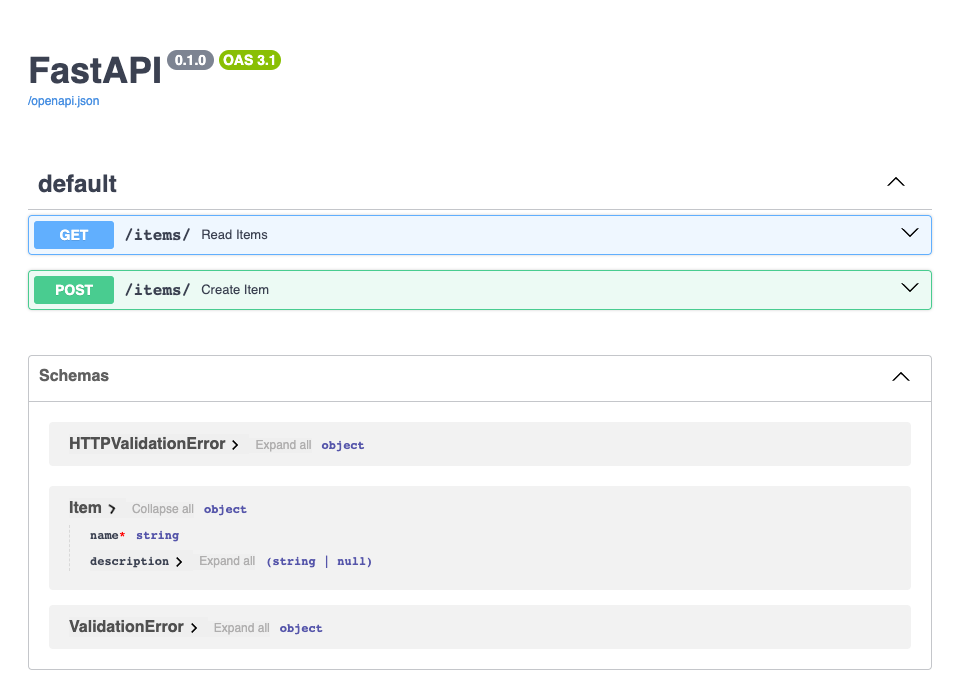
Section titled “Model for Input and Output in Docs”And if you check all the available Schemas (JSON Schemas) in OpenAPI, you will see that there are two, one Item-Input and one Item-Output.
For Item-Input, description is not required, it doesn't have a red asterisk.
But for Item-Output, description is required, it has a red asterisk.
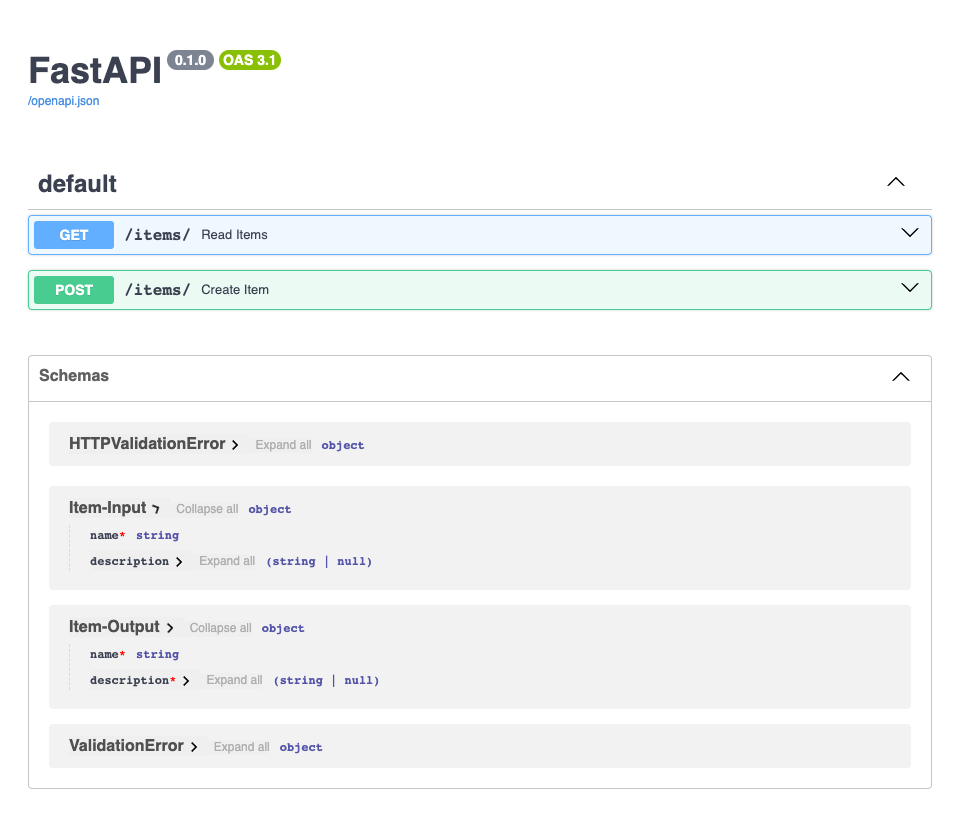
With this feature from Pydantic v2, your API documentation is more precise, and if you have autogenerated clients and SDKs, they will be more precise too, with a better developer experience and consistency. 🎉
Do not Separate Schemas
Section titled “Do not Separate Schemas”Now, there are some cases where you might want to have the same schema for input and output.
Probably the main use case for this is if you already have some autogenerated client code/SDKs and you don't want to update all the autogenerated client code/SDKs yet, you probably will want to do it at some point, but maybe not right now.
In that case, you can disable this feature in FastAPI, with the parameter separate_input_output_schemas=False.
from fastapi import FastAPI
from pydantic import BaseModel


class Item(BaseModel):
    name: str
    description: str | None = None


app = FastAPI(separate_input_output_schemas=False)


@app.post("/items/")
def create_item(item: Item):
    return item


@app.get("/items/")
def read_items() -> list[Item]:
    return [
        Item(
            name="Portal Gun",
            description="Device to travel through the multi-rick-verse",
        ),
        Item(name="Plumbus"),
    ]
Same Schema for Input and Output Models in Docs
Section titled “Same Schema for Input and Output Models in Docs”And now there will be one single schema for input and output for the model, only Item, and it will have description as not required: